



CNN’s Amanpour: The Power Of The Internet?
Did you ever see the interviews of Christiane Amanpour on CNN? She has really coined the claim: The power of the interview. Beside great interviews, I would also like to tell you why she has also coined the term: The power of the internet…
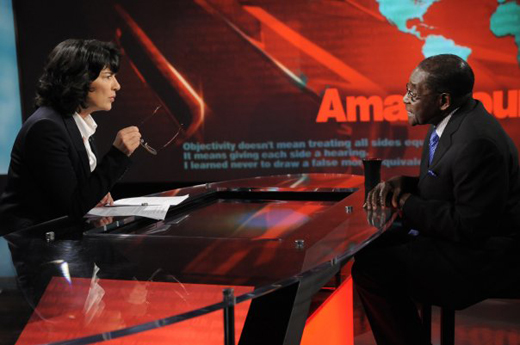
Where most broadcasters still struggle how to connect users to their show with the help of social media, CNN really seems to have found a great format or formula.
First, please take a look at the Amanpour website on CNN. The site is crystal clear in navigation and usability. But the site also offers you many opportunties to stay connected to the show or be part of the show.
On the Amanpour Blog viewers can join the conversation, share their views, ideas and suggestions on the program’s headlines. But they can also check out the articles, videos and a behind the scenes look.
Via the Amanpour Daily Podcast viewers can watch the entire program on their handheld device or online.
Of course viewers can subscribe to get RSS feeds and e-mail alerts. And yes people can even e-mail the show’s team.
And viewers can get the latest updates from the Amanpour show team on the Facebook Fan page and Twitter.
And viewers can watch the interviews in the webcasts and submit their own films.
What am I trying to state here? That CNN has really integrated internet and social media in a relevant and smart way. WHat can other broadcasters (and brands) learn from this approach?
Connect viewers to your show! Ask them to submit their questions for the guests on a blog, Facebook or Twitter. Let the show host or anchor put the viewers questions to your guests.
You could almost call it: doing it the Obama way. Yes, social media marketing can be this simple. Just treat your audience like you care about them. Small effort or a big step in mentality and DNA?

Follow us on Twitter, sign up for our weekly e-mail or watch the ViralTracker social video metrics demo.


I totally agree that social media is a must in what comes to news network. Although it already happened to me (more than once) while watching some ‘important’ event in CNN (for example night that Obama got elected or when USA was attacking iraq) that CNN showed tweets that were ‘pretty agressive’. In my opinion that shouldn’t be in national tv in such a prime time, due to not representing the whole population.
My point is not trying to restrict the power of users to share their opinion, what I think is that should be some restriction in what is shown, specially in networks such as CNN that started to be popular with the gulf war (20years ago) and since then, in my opinion, is the most serious network in what comes to news.
Do the viewers really want to hear what Joe, the plumber has to say?
Hi Alexandre,
Nice point you are making. Do you actually question if large stations like CNN or large institutes should not listen or show what Joe the plumber has to say?
I think sole purpose of CNN is to attract as many Joe the plumbers in the world to watch their show?
So in other words, I understand your vision but do not share it. I thought it was all about Joe the Plumber? Even for the large global players: without Joe they would not exist..
At least, if I see the Obama approach… He made the difference by opening “his windows” and finally somebody reached out to all those Joe’s..
Cheers
I totally agree with that, honestly.
What I’m talking here is major prime time TV, where the target group possibly is not that interested in comments such as “@joe hell yeah, rock on Obama” or “@mary I don’t think the TV host is sexy”.
In this context, and i repeat in this context, I think social media should be restricted, cause let’s agree with that, that’s just something outside the scope of CNN.
What I’m afraid of is that because social media is what it is, people would just accept the information coming from it without even thinking the purpose of it all. (this case being in line with the objectives of the TV network: passing to the audience clear information — if there are tweets out there that comply with that, then I’m the first saying they should be shown!)
They are using new media in interesting ways, however what seems complicated to me is the fact that the audience inevitably has to use TWO devices (a computer and a television) in order to fully participate.
The idea of watching the show through the Daily Podcast, on the interweb, seems wiser to me.
On another note, I actually found the website to be eye-hurting, and far from crystal-clear…
RT @elizabethcnn: I’m so proud of @samuelcnn ! He’s the force behind @amanpourcnn ‘s website. tech community is taking notice too! http://bit.ly/aePuep
I like to party, not look articles up online. You made it hppean.
Hi Laurent
Thanks for your feedback. Hopefully interactive tv will develop in a way that will enable us to interact via the tv in the near future?
Haha, eye-hurting, are you referring to the colourscheme used? Looks a bit devilish maybe…?
Cheers
Igor
Haha, yes, the color scheme is eye-hurting, they’re trying too much… in my opinion, the most ergonomic website are the most simple and sober!
Interesting debate!
Honestly, the trend of asking the people on the street their opinion on the latest news annoys the hell out of me.
I watch the news to hear about what is going on in the world from people who know what they are talking about. Do I care about what ‘Joe the Plumber’ thinks of the Iran Election? Hell now! I care about the opinion of the journalist reporting on the story, who has in depth knowledge of the situation.
So no, I don’t care about Joe the Plumber. Having said that, I do care what my friends think – which is why I often watch TV and big events whilst I am on Twitter at the same time.
And to further build on that, I think it is great CNN is integrating social media into their website and programs – feedback should be welcomed and 2 way interaction is great. But it should not overtake the role of the journalist.
I agree on two of your points: opinions from random citizen are useless, and even dangerous, as they can stir hate and disgrace. And yes, every communication should be bidirectional. The tools to do so are easily accessible and audiences are becoming more and more used to being able to comment, feedback, etc.
RT @elizabethcnn: I’m so proud of @samuelcnn ! He’s the force behind @amanpourcnn ‘s website. tech community is taking notice too! http://bit.ly/aePuep
# Daan
I can imagine. I do have the seem with flirting and texting teens in the MTV overlays.
But what I find interesting is that local Joe’s can help us understand the emotions in a certain region that we have never been.
So I do like to get skilled journalists to tell their story, but I would also like to see how people in that region perceive the developments.
You can imagine that the book “Son of Hamas” and the interview on CNN brings up very emotional reactions from both Palestinians and Israeli’s.
That emotions and reactions make it more “real and tangible” to me. And that goes for many local news facts: CNN can only show a small part of that.
To me citizen journalism or reactions at least show the impact from both sides. That Joe’s give me a broader scope of the impact on real people in that area. Info that helps me to grasp how deep the impact can be. Info that I miss since I have never been in such a region.
Cheers
I would agree with that.
That’s different from what I mean though – the ‘average people’ you are talking about are part of the story.
The average people who are more and more used during news broadcasts are people on the high street who have no relevance to the story whatsoever.
Must admit that you have a point here!
Cheers
RT @elizabethcnn: I’m so proud of @samuelcnn ! He’s the force behind @amanpourcnn ‘s website. tech community is taking notice too! http://bit.ly/aePuep
[...] CNN’s Amanpour: The Power Of The Internet? (viralblog.com) [...]